


Leather Manufacturing · Argentina
An icon of excellence in the global leather industry.
Tradition, technology and commitment to the environment.
History and tradition in leather
History
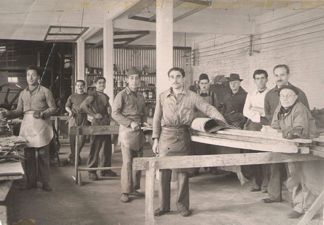
The story begins around 1885, when a Frenchman named Gibaut from the Val-de-Marne south of Paris arrived in the country. Around 1888 Henri Félix Gibaut, together with his son Paul, decided to start tanning hides in Argentina. Thanks to the experience brought from France and his personal efforts, he earned a silver medal at the First National Exhibition in 1898.
In 1910 Don Pablo Alberto Gibaut was born, grandson of Henri and founder of the company that continues the family tradition to this day. He was raised among upholsterers and tanners, learning the family techniques through daily practice.

Around 1924 products were shipped to France, the family’s first export. In 1932 Don Pablo Alberto Gibaut founded Gibaut y Cía SRL; in 1945 his brothers Marcelo, Emilio Félix and Eduardo Ángel joined and Gibaut Hermanos was born. In 1950 the company became a limited partnership and in 1961 adopted its current name: Gibaut Hermanos Manufactura de Cueros S.A.
In the 70s and 80s the company underwent continuous expansion. It appeared alongside other national firms at the International Leather Fair in Paris, showcasing its products to the world; exports accounted for around 90% of sales by 1990.
Also in the 70s a new plant was built in Florencio Varela with state-of-the-art machinery and an effluent treatment plant that became a benchmark for the industry in Argentina. That plant was expanded in the 90s with a finishing line, enabling the full tanning process to be carried out in a single facility.

Trade fairs
We participate in ExpoCAIPIC, Argentina’s leading leather and leather goods fair, and in SIC – Semaine Internationale du Cuir in Paris and Hong Kong, strengthening our ties with the global market.
The present
Over the last three decades our company has gone through many changes: economic crises (Tequila, Asian crisis), transformation of the global leather market, and the emergence of China and Hong Kong with new demands. To endure, companies had to adapt.
Today the company remains firmly in the international market and is expanding its presence in Europe, India and Vietnam with the same quality that has made Gibaut Hermanos (or “G Brand” for Asian clients) a benchmark in the industry worldwide.
We have been certified by the Leather Working Group (LWG) since 2017 and hold Silver rating. We currently produce over 1,000 hides per day, supplying customers in Argentina and around the world with superior finished leather and jointly developing new products to meet their requirements. Many global brands have used our leather; we are proud to have been chosen throughout our history.

The future
Speaking of the future involves aspirations, expectations, challenges and goals. We aim to maintain the highest quality in our leather as we have done for so long, and we look forward to working with customers and suppliers to develop ever better products.
Among our goals are increasing production while reducing water and chemical consumption. We will continue with existing recycling programmes and add others.
We cannot foresee every challenge ahead, but the people who make up Gibaut Hnos. S.A. will join forces and skills to find the right solutions.

Leather and leather goods
Our main lines: Footwear and Leather goods. Different products call for different processes; we have a wide variety of machinery to perform the necessary operations. Below, the leather process step by step.
The leather process
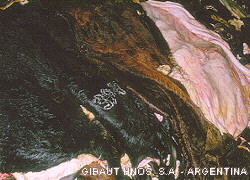
1. Hide receipt
Since raw material is a key factor in the process, hides arriving from slaughterhouses undergo quality control, then trimming and grading.
2. Beamhouse
This mechanico-chemical process takes place in drums or vats. It removes the hair and opens the leather fibres to improve absorption of the chemicals to be applied in later steps.
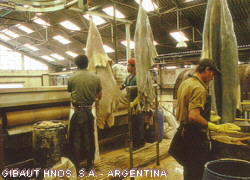
3. Fleshing
After leaving the beamhouse drums or vats, the fleshing machine removes any remaining flesh and fat still attached to the hide.
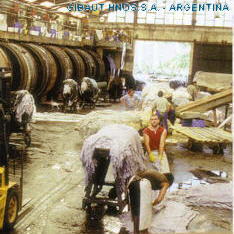
4. Tanning
The main process: it turns a perishable product into a durable, stable one through chromium and other tannins absorbed by the fibres. Total time is 24 h, in three stages: liming, deliming and pickling.
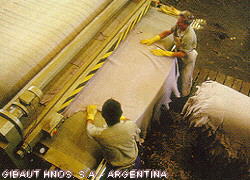
5. Setting out
Using cylinders and absorbent felts at high pressure, moisture is reduced to approximately 60%, the leather is stretched and prepared for the following steps.
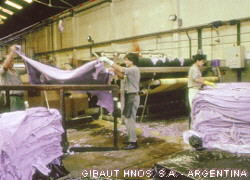
6. Splitting
The machine brings the leather to the desired thickness and yields a by-product, the split, which can be sold as “wet blue” or undergo further processing for finishing.
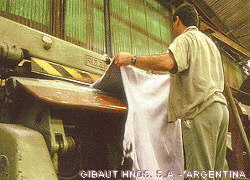
7. Shaving
Running at 2700 rpm, this machine achieves a uniform thickness across the entire surface of the leather.
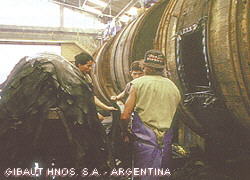
8. Dyeing
With high-quality dyes and other specific products, the desired colours are obtained and fat lost in previous steps is restored, achieving the required softness and hand.
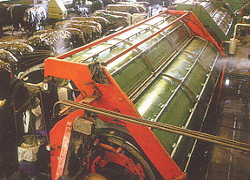
9. Drying
With steel plates at 50–65 °C under vacuum, water is evaporated in a controlled manner and in less time.
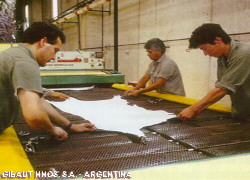
10. Toggling
Complements drying in tunnels and gives the leather a more uniform, smooth surface.
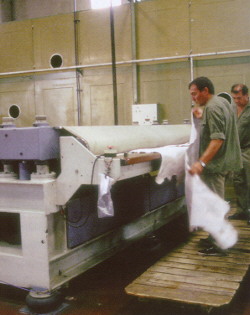
11. Staking
The leather is softened to the required hand; it remains in “crust” state. Some is sold as is and the rest goes on to finishing.
12. Finishing
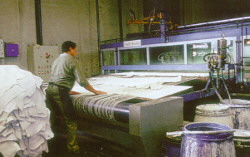
The finishing line can exceed 100 m depending on the product, with several spraying stations and drying tunnels. Different coatings and resins provide gloss, appearance and resistance.
13. Air drying
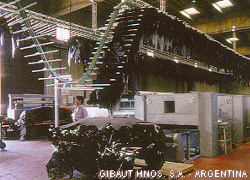
One of the options for finished leather. Different products imply different processes; having diverse machinery is essential.
14. Pressing
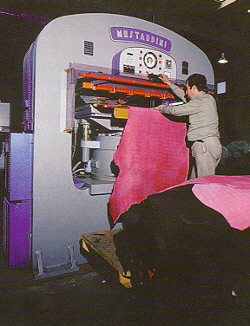
With different temperatures and pressures, the required softness is achieved or, for embossed leather, the desired effect.
15. Measurement and quality
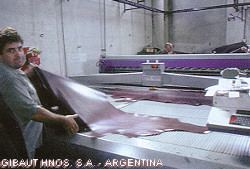
At the end of the process all leather is measured and graded. Data is entered into the system to prepare packing lists and provide feedback on the process.
16. Packing
For export, leather is packed in boxes or crates as required by the customer. Each package is labelled with contents and barcode for shipping control.
Environmental commitment
Tanning involves the transformation of an organic raw material subject to natural decay into one that retains the main characteristics of leather but remains stable and durable over time. This is achieved through various mechanical and chemical processes.
Because leather production operates in a fully global market and a large share of our output is exported, the technical and environmental requirements we must meet hardly differ from those of the world’s main producers. Often, to enter a market or close sales in a given country, compliance with regulations that are sometimes stricter than those in force in our own country is required.
Furthermore, the leather industry has always followed the parameters published by the leading leather technology institutes worldwide (Germany, United Kingdom), which for decades have carried out studies and controls to minimise the environmental impact of production.
In our case, environmental concerns have been a priority since the construction of the new industrial plant in the 70s. The effluent treatment plant has been a model for the industry (photographs and references can be found on the CICA website and that of environmental technology consultants), and production processes are continuously adapted to minimise waste and water consumption.
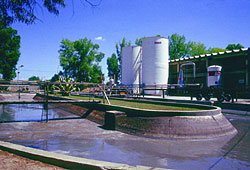
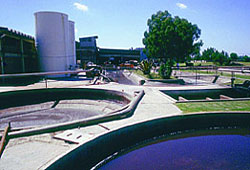
As part of compliance with current regulations, the company prepares and submits reports to municipal, provincial and national authorities on operations and the parameters that must be monitored on an ongoing basis. These include: Annual Environmental Impact Report, ongoing liquid effluent studies, groundwater analysis in monitoring wells, runoff studies and air quality studies.
Chromium and leather tanning
Chromium comes from the mineral chromite. The global leather industry consumes only 1.3% of all chromium produced worldwide; the metallurgical industry is the main consumer (79%), in alloys, chrome plating and electroplating.
The chromium ion can have different valencies, which determine its properties. Tanning uses Cr(III), trivalent chromium, in the form of basic chromium sulphate. This element is not considered hazardous, carcinogenic or teratogenic according to USEPA (40 CFR 261.4 (b)6), 1999. The Basel Convention (Law 23.922) and the National Hazardous Waste Law (24.051) do not include trivalent chromium in the list of hazardous substances.
Trivalent chromium is the most common form of this metal and is present in foods such as meat, brewer’s yeast, bananas, spinach or wheat germ; it is essential for the metabolism of fats, carbohydrates and insulin. By contrast, hexavalent chromium Cr(VI) is a hazardous substance and is not used in tanning.
The company has a chromium recovery plant: all liquids from chrome tanning are processed and recycled, so the chromium used does not leave the production circuit.
Further information: CICA – Argentine Chamber of the Tanning Industry · AAQTIC – Association of Leather Chemists and Technicians · IULTCS – International Union of Leather Technologists and Chemists
Get in touch or visit us
Gibaut Hnos. Manuf. de Cueros S.A.
Prov. Route 36, Km 32.5
Florencio Varela — B1888
Buenos Aires Province, Argentina
Tel. +54 2229 495 870
Fax +54 2229 495 880